Blog · 17 Nov 2026 · 15 min read
Drone listing photos in Canada: Transport Canada rules for realtors (2026)
A drone shot is often the only way to show what a Canadian listing really offers: the lot size, the backyard against the ravine, the walk to the lake, the cottage's frontage. It is also the one listing photo that comes with federal aviation rules. Who flies, what drone they use and where the house sits all change what is legal. This guide is for realtors in Canada who book aerial photos, or fly their own drone, and for the photographers and editors they brief. It sets out what Transport Canada, the Canadian Aviation Regulations (CARs) Part IX, Parks Canada and NAV CANADA say, what that means for a typical listing shoot, and a checklist you can send your drone pilot before you book.
We're the Light & Polish team. We edit listing photos for realtors, including in Canada, and we don't fly drones ourselves. We are not lawyers or aviation advisers. Transport Canada changed parts of Part IX in 2025 and updates its pages, so check the linked pages (Transport Canada publishes them in English and French) before you rely on anything here. For REALTOR.ca, CREA Code and board rules on edited photos, see our earlier guide to MLS and REALTOR.ca listing photos in Canada. This post covers the aerial side it didn't.
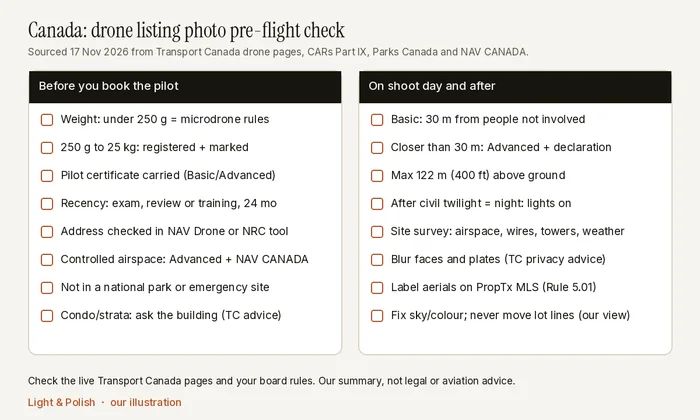
Step 1: what does the drone weigh?
Transport Canada sorts drones by operating weight, and the rest of the rules follow from that. The weight of the remote control doesn't count, but anything attached or carried, such as an optional camera or a safety cage, does (Transport Canada, drone operation categories):
- Microdrones: under 250 g. No registration and no pilot certificate. The pilot still must not fly recklessly or negligently, must stay away from emergency sites, must not enter restricted airspace without permission, and must respect trespass and privacy laws. Transport Canada recommends keeping the drone in sight, below 400 feet, at a safe distance from people and well away from airports and heliports (microdrones page).
- Small drones: 250 g up to 25 kg. Many camera drones fall in this class, though some popular models are sold just under 250 g, so check the spec sheet for the operating weight. The drone must be registered through Transport Canada's Drone Management Portal and marked with its registration number (permanent marker, label or engraving). The pilot must carry a valid pilot certificate, printed or electronic, issued by Transport Canada; no other certification is accepted (registering your drone; flying safely and legally).
- Medium (over 25 kg up to 150 kg) and large (over 150 kg). Not a listing-photo tool. Medium drones need at least an Advanced certificate; large drones are special operations that need permission.
Transport Canada's 2025 summary says drone registration fees rose to $10 on 1 April 2025 (2025 summary of changes). If you fly your own small drone for listings, budget for that and for the exam, and remember that a "light" drone with a heavier battery or accessory fitted can tip over 250 g.
Step 2: Basic or Advanced? The 30-metre test
In our experience briefing shoots, this is the rule that most often changes the plan. A flight counts as a Basic operation only if all of these are true (Basic operations):
- the drone weighs no more than 25 kg;
- the pilot can always see it;
- it stays more than 30 metres (100 feet) horizontally from any person;
- it flies in uncontrolled airspace;
- it stays more than 5.6 km (3 nautical miles) from the centre of a certified airport and more than 1.9 km (1 nautical mile) from the centre of a heliport.
If any one condition isn't met, the flight is an Advanced (or higher) operation. The legal text is section 901.26 of the CARs: a small drone flown in visual line-of-sight must not be less than 100 feet (30 m), "measured horizontally and at any altitude", from any person not involved in the operation (CARs, SOR/96-433). Flying higher doesn't get around it.
Think about a normal suburban listing: a neighbour gardening next door, kids on the driveway across the street, a dog walker on the sidewalk. On a typical residential lot it can be hard to keep everyone not involved 30 m away from the drone for the whole flight. With an Advanced certificate, the Advanced operations page says, a pilot can fly a small drone less than 30 m but more than 5 m from people, or within 5 m and over people, but only if the drone has the matching safety assurance declaration (standards 922.05 and 922.06; Advanced operations).
How pilots qualify, from the same pages: a Basic certificate needs an online exam (minimum age 14). An Advanced certificate needs the advanced online exam, a flight review and an application (minimum age 16); the department lists a $25.00 fee for issuing the certificate. Neither certificate expires, but under CARs 901.56 and 901.65 a pilot must, within the 24 months before a flight, have been issued the certificate or completed an exam, a flight review or approved recurrent training (keep your skills up to date).
Our practical view: if you book a photographer for aerials in a built-up neighbourhood, ask for someone with an Advanced certificate and a drone with the declarations for flying near people. It gives them room to work around neighbours without the shoot stalling.
Step 3: check the address before you book
Where the house is matters as much as who flies. Before the shoot date, the pilot should check the address in NAV CANADA's NAV Drone (app or web) or the National Research Council's Drone Site Selection Tool. Transport Canada's where-to-fly page points to both for airspace, nearby aerodromes and NOTAMs (notices to aviators about temporary restrictions) (where to fly your drone).
- Controlled airspace. Flying here needs at least an Advanced certificate, a drone with the right manufacturer safety declaration, and authorization from the air navigation service provider. For NAV CANADA airspace, Advanced pilots request it through NAV Drone. If the address shows up in controlled airspace, build in time for the request rather than assuming the shoot can happen the same day.
- Near certified airports and heliports. Unless following an established Transport Canada procedure, pilots can't fly closer than 5.6 km to a certified airport or 1.9 km to a certified heliport. Flying within those distances outside controlled airspace needs an Advanced certificate and the procedures in the Transport Canada Aeronautical Information Manual.
- Military aerodromes. Within 5.6 km of a Department of National Defence aerodrome, the pilot needs DND authorization.
Waterfront and rural listings can have surprises too. An aerodrome includes airports, heliports and seaplane bases, and pilots must not fly near any aerodrome in a way that could interfere with aircraft operating there. That is another reason to have the pilot run the check rather than guess from a map.
The check is also a legal step. CARs section 901.27 says no pilot may operate a drone without first doing a site survey to confirm the area is suitable. The survey has to take into account the type of airspace and any NOTAM, nearby aerodromes and other aircraft, the location and height of obstacles such as wires, masts, buildings, cell phone towers and wind turbines, the weather forecast for the flight, and the horizontal distance from people not involved (CARs, SOR/96-433). It's reasonable to ask your pilot to confirm it's done.
Places drones can't go (even small ones)
- National parks. Under the federal drone rules, pilots can't take off or land within a national park, though a park superintendent may allow it in some cases. Parks Canada says all its places are "no drone zones" for recreational use, non-recreational use needs permission from the Field Unit Superintendent, and flying without approval can bring a fine of up to $25,000 (Parks Canada, use of drones). This matters for listings in towns inside parks. The Town of Banff, for example, says drones are not permitted in Banff and that it is inappropriate to permit commercial drone use for promotional reasons (Town of Banff, drones).
- Emergency sites. No flying within the security perimeter of a police or first-responder operation, and not within 9.3 km of a wildfire.
- Advertised events. Any drone, including a microdrone, needs a special flight operations certificate to fly near or at an advertised event. The department defines one as an outdoor event advertised to the public, like a concert, festival, market or sporting event. If there's a street festival or farmers' market next to the listing that day, move the aerials.
Condos, townhouses and strata buildings
Aerials of a condo tower or townhouse complex raise two practical issues: the people around the building and the building's owner.
People. Balconies, terraces, the pool deck and the courtyard all count. The 30-metre rule applies to anyone not involved in the operation, so a Basic pilot can't simply hover beside an occupied balcony.
Permission. Part IX doesn't apply to flights indoors or underground, but Transport Canada recommends getting permission from the building owner and/or occupants before flying indoors, or near or over buildings (where to fly). For a condo or strata, our suggestion is to ask the property manager in writing before booking, since the common elements, roof and amenity areas are not your seller's to offer.
Height. CARs section 901.25 caps altitude at 400 feet (122 m) above ground level, with a separate limit linked to nearby buildings and structures, and higher flights need a special flight operations certificate. Since November 2025 Advanced pilots can also fly "sheltered operations" close to a structure: within 61 m (200 feet) of it horizontally, no more than 30 m (100 feet) above it, and at least 30 m from people not involved (2025 summary). Whether that fits a given tower is the pilot's call.
For the amenity shots themselves (the pool, gym, party room), our view is that a ground-level photo usually does the job better than a drone and needs no flight at all.
Twilight aerials and the "night" rule
Dusk aerials can show off a listing's lighting and setting (our view), but the timing has a legal edge. The CARs define night as "the time between the end of evening civil twilight and the beginning of morning civil twilight". Under section 901.39, a drone flown at night must carry lights that let the pilot or visual observer see it, and the lights must be on. Civil twilight times change with the date and the location, so ask the pilot to check them for the shoot day and plan the drone's lighting.
The other route is to fly in daylight and have the frame edited to dusk afterwards, labelled as a virtual twilight. RECO's October 2026 AI guidance says AI-modified images must accurately reflect the property's permanent features and be clearly labelled as digitally altered (RECO guidance on AI). Our virtual twilight page shows how we do this on ground-level shots. The same edit works on an aerial as long as the house, lot and surroundings stay as they are.
Privacy, neighbours and your MLS board
A drone at 60 metres sees into a lot of backyards. Transport Canada's privacy guidelines say privacy laws apply to pictures and video collected by a drone, and that personal information can include a picture of a person's face or a licence plate number (privacy guidelines for drone users). Its guidance has two parts.
For a paid listing shoot, the commercial section applies. The same page says businesses in Canada must follow PIPEDA (the federal private-sector privacy law) when using drones. Under PIPEDA, the organization must get consent to collect, use and share personal information, and for consent to be valid people must understand what they are agreeing to. PIPEDA doesn't apply to organizations operating entirely within Alberta, British Columbia or Quebec, which have their own private-sector privacy laws, unless the information crosses borders or the organization is federally regulated.
The recreational principles are still a useful checklist. Transport Canada's privacy principles for recreational operators are to avoid capturing personal information you don't need, anonymize what's captured without consent (for example by blurring faces or licence plates), store recordings securely and respond with respect to complaints. For a listing shoot, treat those as the minimum, not a substitute for the commercial consent duty.
The page also warns that some drone use can go further than privacy law, into voyeurism, mischief or nuisance. A short note to the immediate neighbours before shoot day is a simple courtesy that also helps with the 30-metre rule.
Board rules add their own layer. In Ontario, the PropTx MLS® Rules (effective 2 December 2024), Rule 5.01, say images must feature the listed property and its immediate surroundings, including the scenery viewed from it. The rule bans images of surrounding amenities that aren't in view of the property and images of people. It allows "aerial or distance photographs relating to the listed real estate which is labelled as such" (PropTx MLS® Rules, PDF). In practice: label the aerials, keep the frame on the property and what it overlooks rather than a lake three kilometres away, and remove or blur people. Other boards publish their own rules, so check yours.
CREA's REALTOR® Code and RECO's rules on photographer consent apply to aerials as they do to ground photos; our Canada MLS and REALTOR.ca photo guide covers them. In short, get the drone photographer's licence terms in writing.
Fines if the flight breaks the rules
Transport Canada lists these maximum fines on its Basic and Advanced operations pages. If more than one rule is broken, there can be more than one penalty.
| Offence | Individuals (up to) | Corporations (up to) |
|---|---|---|
| Flying without a drone pilot certificate | $1,000 | $5,000 |
| Flying where you are not allowed | $3,000 | $15,000 |
| Putting aircraft and people at risk | $3,000 | $15,000 |
| Flying unregistered or unmarked drones | $5,000 | $25,000 |
| Flying without the required safety assurance declaration (Advanced) | $1,000 | $5,000 |
Insurance isn't required for standard operations, according to Transport Canada, but it is recommended. If your brokerage or team flies its own drone, ask whether your insurance covers it.
A checklist to send your drone pilot
Copy this into your booking email. It doesn't replace the pilot's own planning; it just makes sure the questions get asked before shoot day.
- What drone will you fly, and what is its operating weight with everything attached?
- Is it registered and marked with its registration number? (Not needed under 250 g.)
- Which pilot certificate do you hold, Basic or Advanced? When did you last do an exam, flight review or recurrent training, or get your certificate? It must be within the last 24 months.
- Have you checked the address in NAV Drone or the NRC tool? Is it controlled airspace, or near an airport, heliport or military aerodrome? If so, do you have NAV CANADA or DND authorization?
- Will the drone stay 30 m from people not involved? If not, does your drone have the declaration for flying near or over people?
- Is the property in or next to a national park, or is an advertised event nearby that day?
- For condo, townhouse or strata buildings: have we got the property manager's permission in writing?
- For dusk aerials: will you finish before the end of civil twilight, or does the drone have the lights needed for night flight?
- Will you blur faces and licence plates, and keep people out of the frames we upload?
- What are your licence terms for the photos and video, and how long can we use them?
Want to be your own pilot? Start with Transport Canada's learn the rules hub (French version for Quebec teams) and read Part IX in full, as the department itself advises.
Editing aerial photos: what we'll do and what we won't
Once the aerials come back, the problems are usually the same: a flat grey sky, colour washed out by haze, and a neighbour's car or a passer-by in the frame. This is our view of fair edits for Canadian aerials:
- Fine to do: sky replacement on a grey day, colour and white balance correction, straightening the horizon, blurring faces and licence plates, removing a passer-by or a parked car that isn't part of the sale.
- Fine if labelled: virtual twilight on a daytime aerial; a simple outline or arrow marking the property, if your board's rules allow it and the outline comes from the survey or plan of the lot, labelled "approximate".
- We refuse: moving or widening lot lines, removing hydro lines, towers, a neighbouring building or a highway, adding greenery to a bare lot, or making water look closer than it is. Those change what the buyer gets, which runs against CREA's REALTOR® Code, Article 13 (advertising must accurately reflect the property; REALTOR® Code, PDF) and RECO's AI guidance.
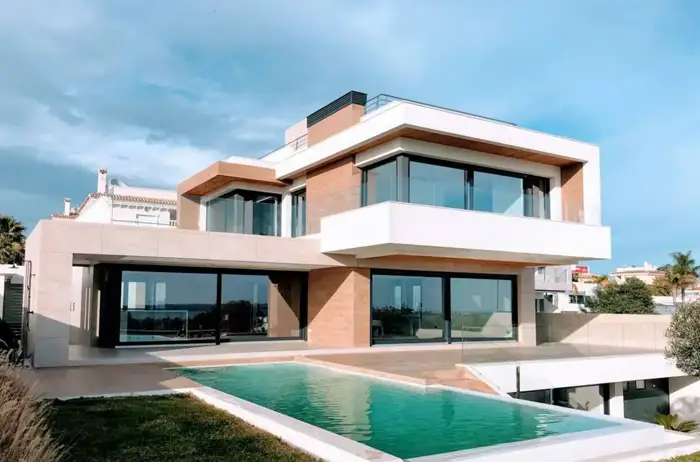
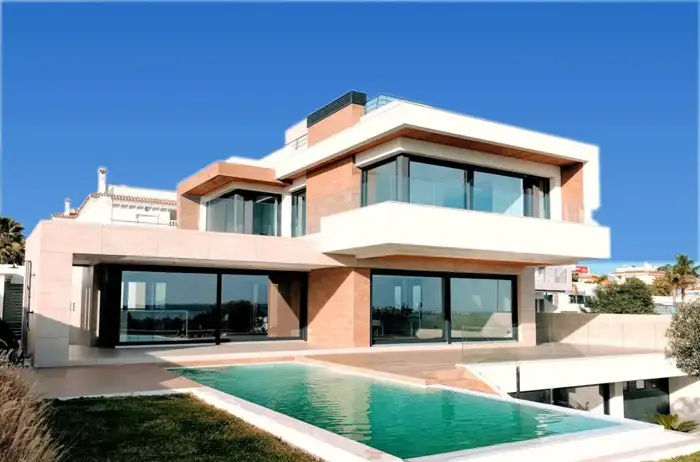
For more on the edits themselves, see sky replacement for real estate photos, our guide to disclosing AI-edited listing photos and how to brief a photo editor on MLS rules.
Listing in Quebec? Our guide to Quebec listing photos and OACIQ rules covers the AI-image statement, keeping originals, photo copyright, "sold" banners and French text on graphics.
What it costs to have us edit the set
From our pricing and listing photos pages: first listing US$29, then US$32 per listing, or US$229 a month for regular listings (prices exclude local taxes). Aerials are edited along with the rest of the set. Edits come back within 24 hours, and you pay after delivery. If you'd like to judge the style first, send us one photo (an aerial is fine) for a free sample edit at hello@lightandpolish.com or through our contact page. More on how we work with Canadian realtors is on our Canada page.
Frequently asked questions
Do I need a drone licence to take listing photos in Canada?
It depends on the drone's operating weight. Transport Canada says drones under 250 g (microdrones) don't need to be registered and the pilot doesn't need a certificate, but microdrone rules still apply. Drones from 250 g up to 25 kg must be registered and marked, and the pilot must carry a Transport Canada pilot certificate. A Basic certificate covers a flight only if the drone stays more than 30 m horizontally from anyone not involved, in uncontrolled airspace, more than 5.6 km from a certified airport and more than 1.9 km from a heliport. Otherwise the pilot needs an Advanced certificate.
Can a drone fly closer than 30 metres to the neighbours?
Not under Basic operations. Section 901.26 of the Canadian Aviation Regulations says a small drone flown in visual line-of-sight must stay at least 100 feet (30 m), measured horizontally and at any altitude, from anyone not involved in the operation. A pilot with an Advanced certificate can fly closer (between 30 m and 5 m), according to Transport Canada, if the drone has a safety assurance declaration for that kind of operation. Flying within 5 m of people or over them needs a separate declaration.
Can I fly a drone for a twilight exterior?
The regulations define night as the time between the end of evening civil twilight and the beginning of morning civil twilight. Section 901.39 says a drone flown at night must have lights that let the pilot or visual observer see it, and those lights must be on. Ask your pilot to plan the timing. Another option is a daytime aerial edited to dusk, labelled as a virtual twilight.
Do aerial photos need a label on MLS?
On the PropTx MLS System in Ontario, Rule 5.01 allows aerial or distance photographs relating to the listed property as long as they are labelled as such. The same rule bans images of nearby amenities that can't be seen from the property, and images showing people. Other boards set their own rules, so check your board's MLS rules before uploading.
Our services: Real estate photo editing (first listing US$29) · Real estate photo editing canada · Free listing photo checklist (PDF)
Related
- Real estate listing photo editing
- Quebec listing photos: OACIQ AI label, French text and sold banners (2026)
- How much does drone photo editing cost for real estate? (2026 prices)
- How much does 360° virtual tour editing cost? (2026 prices)
- Dubai holiday home listing photos: DET permit and platform rules (2026)
- How much does real estate video editing cost? (2026 prices)
- Drone listing photos in Australia: CASA rules for agents (2026)
This article is general information, not legal advice. Rules change; check the linked official sources.